

Emergency Semi Road services: What to Do While Stranded
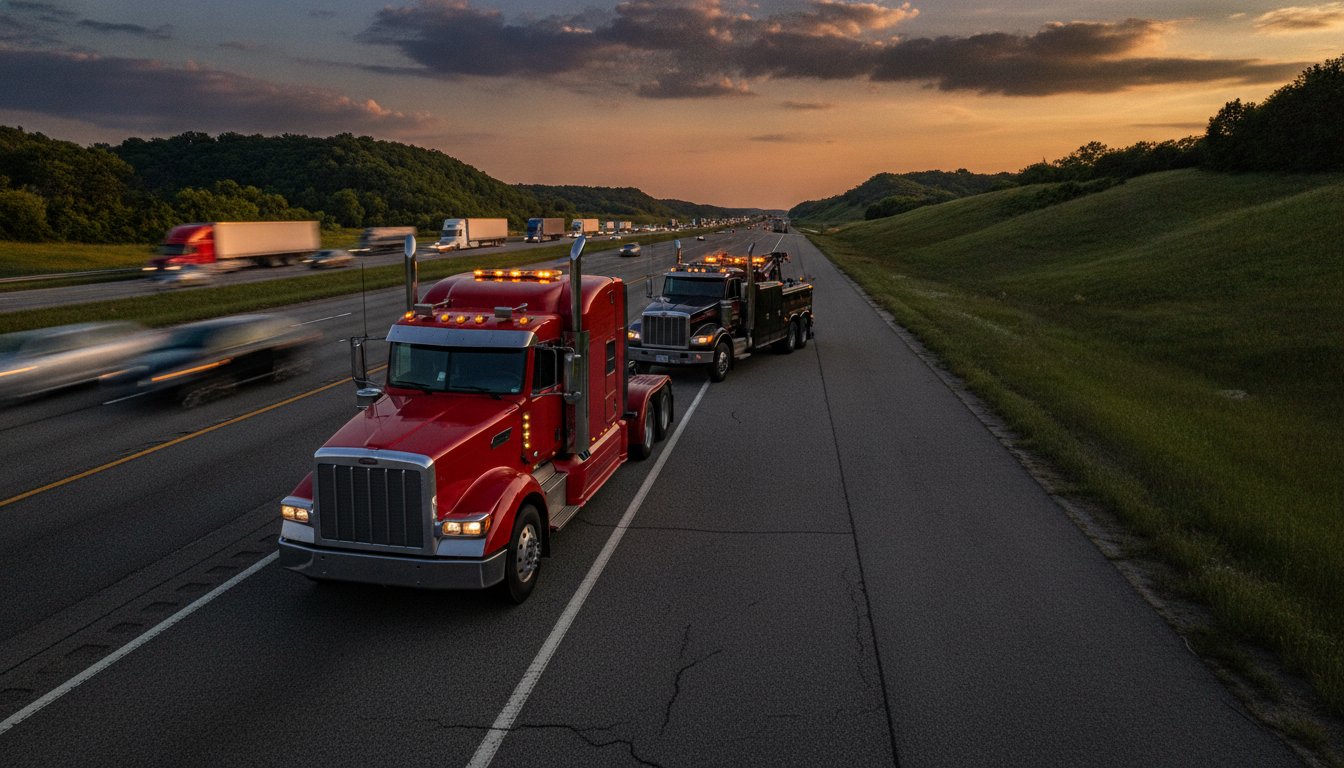
Imagine you're hauled up on the shoulder of I-24 near Nashville, watching traffic fly by while your delivery window disappears. With Tennessee hosting eight of the nation's top 100 truck bottlenecks and recording 2,262 semi-truck accidents in 2025, a breakdown is a high-stakes financial and safety emergency. You're likely worried about the risks on the road and the staggering cost of an unnecessary heavy-duty tow. Securing a fast, reliable emergency semi road rescue shouldn't feel like a gamble with your revenue.
We understand that every minute your wheels aren't turning, you're losing ground. You need a plan that prioritizes a rapid return to service and keeps your equipment out of the tow yard. This article teaches you exactly how to handle a heavy-duty breakdown, stay safe on a high-speed shoulder, and use expert roadside strategies to get moving again. We'll walk through essential safety protocols, accurate diagnostic steps, and the communication tactics that turn a potential disaster into a manageable repair.
While this guide offers a starting point for managing emergencies, a deep understanding of commercial vehicle safety is best developed through professional instruction. For those looking to start their career or enhance their operational knowledge, Lone Star Truck Driving Academy provides the rigorous CDL training needed to handle high-pressure roadside scenarios safely.
Key Takeaways
- Secure your perimeter immediately by following legal triangle placement rules to avoid rear-end collisions from high-speed traffic.
- Learn to diagnose air brake leaks and tire failures to ensure your emergency semi road rescue team arrives with the correct parts for a fast fix.
- Evaluate the financial impact of on-site mobile repairs versus the high cost of heavy-duty towing and recovery fees.
- Identify high-risk breakdown zones on I-24 in Middle Tennessee to better prepare for regional safety and weather challenges.
- Understand how advanced diesel diagnostics can identify DOT out-of-service violations before you commit to a repair strategy.
What Should I Do Immediately After a Semi-Truck Breakdown?
A sudden mechanical failure on a busy corridor like I-24 is a high-stakes emergency. You have seconds to react before your rig becomes a stationary hazard in a high-speed environment. Your first priority isn't the engine; it's your life and the safety of other drivers. When you realize the truck is failing, move to the shoulder as far as possible while you still have momentum. Securing an emergency semi road rescue starts the moment you stop moving. Don't hesitate to prioritize visibility over everything else.
Securing the Rig and Setting Up a Safety Perimeter
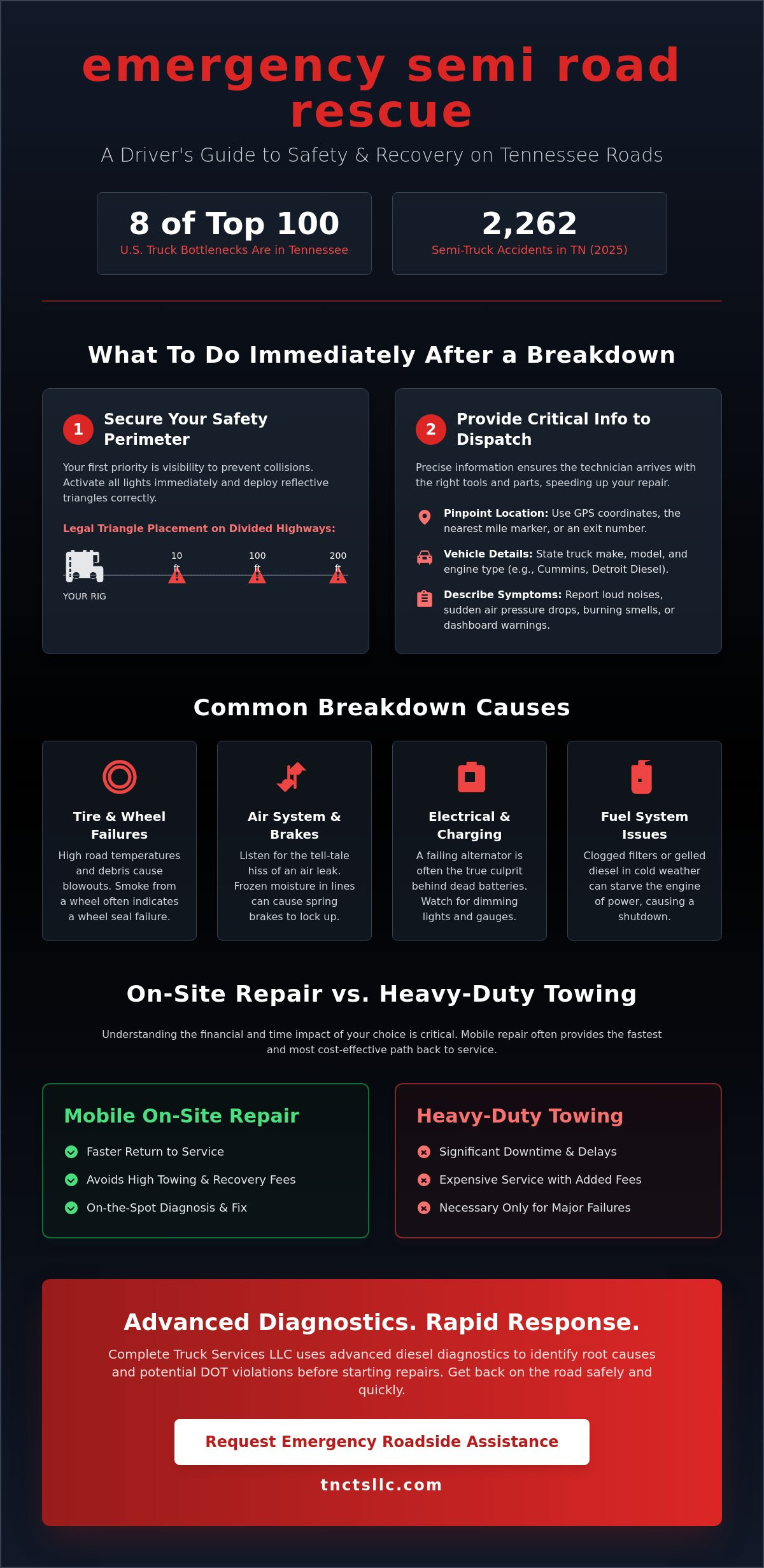
Activate your hazard lights and any auxiliary lighting immediately. On a divided highway, the law requires specific triangle placement to give other drivers enough reaction time. Place your first reflective triangle 10 feet from the rear of the trailer on the traffic side. Position the second one 100 feet back, and the third 200 feet from the rig. This 200-foot buffer is critical. It provides a visual warning for motorists traveling at 70 mph or faster. While you're outside the cab, keep a sharp eye on oncoming traffic and never turn your back to the road. You should also verify ground stability before deploying landing gear or jacks on the shoulder. An 80,000-pound load can easily sink into soft mud or crumbling asphalt, creating a secondary recovery crisis. If the terrain looks unstable, stay in the cab with your seatbelt fastened until help arrives.
Essential Information for the Road Rescue Dispatcher
When you call for an emergency semi road rescue, the precision of your information determines the speed of the repair. Don't just say you're on the interstate. Use your GPS coordinates or the nearest mile marker and exit number to pinpoint your location. Tell the dispatcher the truck's make, model, and specific engine type, such as a Cummins or Detroit Diesel. This ensures the mobile technician arrives with the correct diagnostic software and specialized tools. Describe the symptoms with as much detail as possible. Did you hear a loud metallic bang? Did the air pressure drop suddenly, or do you smell burning electrical components? These details help the team perform a preliminary diagnosis over the phone. Accurate reporting helps the technician determine if the rig can be fixed on-site or if you truly need a heavy-duty tow truck to clear the lane. Clear communication is the fastest way to get your freight moving again.
Common Causes for Emergency Semi Road Rescue
Mechanical failures rarely happen in a vacuum. They usually announce themselves with a loud bang, a persistent hiss, or a sudden loss of throttle response. When your rig stops, a fast and accurate diagnosis is the difference between a quick roadside fix and a multi-hour wait for a tow. Understanding the root cause helps you provide better information during an emergency semi road rescue call. It ensures the mobile technician arrives with the correct parts for your specific diesel engine or trailer configuration.
Tire blowouts and wheel seal failures are among the most frequent culprits. High road temperatures on I-24 can cause old rubber to disintegrate, while debris can puncture even the toughest casings. If you notice smoke coming from a wheel end, it's likely a wheel seal failure that has leaked oil onto the hot brake components. Similarly, fuel system problems like clogged filters or gelled diesel in the winter can starve your engine of the power it needs to climb steep grades. These issues are often fixable on the shoulder if you have the right mobile support.
Air System and Brake Failures
Listen closely for the telltale hiss of escaping air. An audible leak in the tractor or trailer lines often triggers the emergency spring brakes, which lock your wheels in place instantly. In cold weather, "maxi" brakes frequently fail to release because moisture has frozen within the lines. You shouldn't try to thaw these lines with an open flame. This creates a severe fire risk and can melt the air hoses. Professional technicians use specialized heaters or de-icing agents to restore pressure safely. Maintaining high standards for truck breakdown safety requires addressing these leaks before they lead to a complete system lockup on a high-speed highway.
Electrical and Charging System Issues
Electrical failures often hide their true source. A truck that won't crank might seem like it has dead batteries, but the real issue is often a failing alternator. If your alternator isn't charging the system while you drive, your batteries will eventually drain to zero. Look for dimming lights or fluttering dashboard gauges as early warning signs. Jump-starting a semi-truck is a technical task. It requires specialized heavy-duty equipment to manage the high amperage needed for large diesel engines. Using underpowered cables or improper techniques can damage sensitive electronic control modules. If you're facing a "no-crank" situation, it's best to contact a professional for 24/7 road rescue to avoid costly damage to your electrical system.
Mobile Repair vs. Towing: Which Is Right for Your Situation?
When your rig stops, you face a critical financial decision. You have to choose between calling for an emergency semi road rescue or summoning a heavy-duty wrecker. This choice isn't just about the mechanical fix; it's about protecting your revenue and your delivery schedule. A heavy-duty tow often involves high hook-up fees and per-mile charges that can quickly erode your profit for the entire week. Beyond the cost, towing usually means your truck will sit in a shop's overflow lot for days before a technician even looks at it. Evaluating the severity of the failure immediately helps you avoid these unnecessary delays.
Time-sensitive cargo demands a roadside solution whenever possible. Most common issues that trigger a breakdown are manageable without moving the vehicle. If your mechanical failure results in a DOT out-of-service violation, such as a major air leak or a flat tire, you're legally prohibited from moving the truck. In these cases, a roadside fix isn't just the faster option; it's the only way to remain compliant and avoid heavy fines. Staying put and requesting on-site assistance is often the safest and most efficient path back to the road.
When to Insist on a Roadside Repair
Mobile technicians can handle more than you might think. Tire replacements, wheel seal repairs, and air line fixes are standard procedures for an emergency semi road rescue unit. Even complex electronic issues, like forced DPF regens or sensor swaps, are frequently resolved on the shoulder with advanced diagnostic tools. Mobile repair avoids the high hook-up fees and per-mile charges associated with heavy-duty wreckers. If the truck can be safely repaired in its current location, you save hours of downtime and keep your freight moving toward its destination.
When a Heavy-Duty Tow Is Unavoidable
Some situations leave you with no choice but to call for a tow. Major internal engine failures, catastrophic transmission damage, or a blown differential require a shop environment with heavy lifting equipment. Structural trailer damage that compromises the safety of the load also mandates a tow to a secure facility. Maintaining large truck safety is paramount, especially when your vehicle is stuck in a "live lane" where traffic cannot safely navigate around you. If a repair cannot be completed quickly and safely on the shoulder, moving the rig to a controlled environment is the only responsible course of action.
If you find that the cost of these major repairs exceeds your vehicle's remaining value, you may need to look for liquidation solutions. For readers managing assets in the Midwest, Cash For Junk Cars Michigan offers a straightforward way to turn damaged or non-running vehicles into immediate capital.
Maintaining the integrity of your business assets extends beyond the road to your physical facilities. For professionals who require high-quality property maintenance in Oklahoma, Rescue Roofing Tulsa offers specialized commercial and residential roofing services to protect your investments.
Navigating Roadside Emergencies on I-24 and Middle Tennessee
Middle Tennessee presents unique logistical hurdles for truck drivers. The stretch of I-24 between Clarksville and Nashville is a high-volume corridor where a mechanical failure can quickly escalate. According to 2026 data from the American Transportation Research Institute, the interchange of I-24/I-40 at I-440 in Nashville is the 7th worst truck bottleneck in the nation. When you're stranded in these high-risk zones, local knowledge is your greatest asset. Understanding regional traffic patterns helps you anticipate how quickly an emergency semi road rescue team can reach your location during peak congestion hours.
Navigating the rolling hills of Middle Tennessee puts significant strain on your drivetrain and braking systems. While the famous Monteagle grade is further south, the Clarksville area features its own challenging terrain that tests your equipment's limits. If your truck fails while hauling a maximum Tennessee weight of 80,000 pounds, the stakes for safety and recovery are incredibly high. You need a partner who knows the local exits and the safest spots to pull over when the shoulder disappears. Efficiency isn't just about the fix; it's about knowing the road.
Maintaining a high-performance drivetrain is essential for any vehicle facing steep inclines or long hauls. For enthusiasts who apply this same logic to their personal vehicles, you can explore Superlite motorcycle sprocket and chain kits to ensure your bike is equipped with professional-grade components.
I-24 Breakdown Hotspots and Safety
Breakdowns near the Clarksville and Kentucky border are particularly dangerous due to high-speed freight traffic merging from I-24 and local routes. Bridges and overpasses along this route often have narrow shoulders that barely accommodate a standard trailer width. If you find yourself in one of these "zero-clearance" zones, don't attempt to exit the cab on the traffic side. We recommend coordinating with local law enforcement for traffic control. Having a patrol car with flashing lights behind your rig provides a necessary layer of protection for you and the technician performing the repair. This proactive approach prevents the rear-end collisions that contributed to Tennessee's 2,262 semi-truck accidents in 2025.
Local Climate Impacts on Heavy-Duty Trucks
The climate in Montgomery County and Oak Grove can be unforgiving. Sudden cold snaps in late autumn often catch drivers off guard, leading to gelled diesel and frozen air lines. Conversely, the intense humidity of a Tennessee summer places extreme stress on cooling systems. If your radiator or water pump fails during a humid haul, the engine can overheat in minutes. For drivers who want to prevent these crises before they start, it's worth reviewing our guide on Professional Semi-Truck Repair in Clarksville TN. Establishing a maintenance routine helps your fleet survive the local weather extremes. If you're currently stranded and need immediate help, get 24 hour truck repair now to restore your operations.
How Complete Truck Services LLC Executes Road Rescue
Complete Truck Services LLC stands as a critical link in the Clarksville supply chain. We recognize that every hour your truck sits idle represents a direct hit to your bottom line. Our team doesn't just provide a service; we offer a 24/7 commitment to getting you back on the road. Local fleet managers trust our rapid intervention because we understand the urgency of an I-24 breakdown. We combine mechanical grit with polished service standards to ensure your cargo stays safe and your schedule remains intact. Our goal is always a rapid return to service through precise technical execution.
Mechanical failures on heavy-duty rigs require more than just a wrench. They require a deep understanding of complex diesel systems and trailer architecture. Whether you're dealing with a reefer unit failure that threatens perishable cargo or a diesel engine that has entered limp mode, our technicians have the expertise to intervene. We focus on on-site restoration to keep your fleet moving without the added delay of a shop queue. Reliability is our hallmark, and speed is our standard.
Our Roadside Diagnostic Capabilities
A technician's expertise is only as good as their tools. We equip our mobile units with OEM-level software to perform deep-system scans right on the shoulder. This allows us to clear fault codes and perform forced regens without needing a shop visit. Our units are fully stocked mobile workshops. We carry common air line fittings, sensors, belts, and specialized tools for diesel engine services. This preparation is why we can resolve most mechanical issues on-site. Our technicians prioritize your safety by establishing a secure work zone before beginning any trailer repair or engine work. We move with precision to minimize your downtime and maximize your return to service.
Getting Help Now: The Complete Truck Services Process
When you call our 24-hour emergency line, you're not reaching a distant call center. You're speaking with a local partner who knows the Clarksville area and the specific challenges of Middle Tennessee logistics. We provide immediate transparency regarding arrival times and repair estimates. There's no guesswork involved. Once our technician arrives, they perform an accurate roadside diagnosis to determine the most efficient path forward. Whether it's a complex electrical failure or a routine tire swap, we execute the repair with speed and technical precision. Don't let a mechanical failure derail your entire week. You can contact Complete Truck Services for 24/7 Road Rescue right now to get your wheels turning again. We are your steady hand during an emergency semi road rescue, ensuring you bypass the tow yard and get back to business.
Restore Your Fleet's Momentum Today
A roadside breakdown is a test of your preparation and your partners. You now have the strategies to secure your rig, diagnose mechanical failures accurately, and choose the most cost-effective repair path. Prioritizing visibility on high-speed shoulders and providing precise data to dispatchers are the fastest ways to bypass the tow yard. Whether you're facing a sensor failure or a locked brake system, a proactive approach ensures your cargo reaches its destination safely.
Complete Truck Services LLC is ready to act as your dependable partner when the stakes are highest. Our 24/7 Rapid Response Unit and expert diesel technicians specialize in restoring operations for drivers throughout the Greater Clarksville Area. We focus on technical precision and speed to eliminate the stress of operational downtime. If you're currently stranded on I-24 or need a reliable team on standby, we have the advanced diagnostics to handle your emergency semi road rescue with absolute efficiency.
Get 24/7 Emergency Semi Road Rescue Now and experience the relief of a professional restoration. Stay safe, stay informed, and keep your freight moving forward.
Frequently Asked Questions
How long does a typical emergency semi road rescue take?
Most emergency semi road rescue calls see a technician arrive within 60 to 90 minutes, though this depends on traffic density near Nashville or Clarksville. Simple repairs like tire swaps or air line fixes often take less than an hour once the technician is on-site. Complex electronic diagnostics may extend the time. We prioritize speed to ensure your downtime remains minimal.
Can you perform a forced regen on the side of the highway?
Yes, we can perform a forced DPF regeneration on the shoulder using OEM-level diagnostic software. If your truck has entered "limp mode" due to soot buildup, our mobile units can initiate the process to clear the restriction. This on-site intervention saves you from an expensive tow and gets your diesel engine back to full power quickly.
Is it safe to stay in the cab during a roadside repair?
Staying in the cab with your seatbelt fastened is often the safest option if your truck is parked on a narrow shoulder with high-speed traffic. However, if the technician needs to work near the cab or if there's a risk of a secondary collision, they may advise you to move to a safer location behind a guardrail. Always follow the safety instructions provided by your roadside technician.
What is the most common reason for a semi-truck breakdown on I-24?
Tire blowouts and air system leaks are the most frequent causes of breakdowns on the I-24 corridor. The combination of high road temperatures and heavy freight loads often leads to rubber failure or wheel seal leaks. Air leaks are also common, particularly when moisture in the lines freezes during Tennessee cold snaps or when vibration causes fittings to loosen over long hauls.
Do you provide roadside assistance for reefer trailers?
Yes, we provide specialized roadside assistance for reefer trailers to protect your temperature-sensitive cargo. Our technicians can diagnose cooling unit failures, fuel delivery issues, and electrical faults on-site. Rapid intervention is critical for refrigerated loads to prevent spoilage and cargo loss. We treat these calls with the highest priority to keep your freight viable.
Can you fix air brake leaks on the shoulder?
We can repair most air brake leaks directly on the shoulder. Our mobile units carry a wide variety of fittings, hoses, and valves to resolve audible leaks that trigger emergency spring brakes. Since air leaks often result in a DOT out-of-service violation, fixing the issue on-site is the most efficient way to avoid fines and stay compliant while returning to service.
What information should I have ready when I call for road rescue?
You should have your exact mile marker, the truck's make and engine type, and a detailed description of the symptoms ready. Tell the dispatcher if you heard a loud noise, lost air pressure, or saw dashboard warning lights. This specific information helps our technicians arrive with the correct tools and parts to execute a successful emergency semi road rescue on the first attempt.
Do you offer 24/7 truck repair in Oak Grove and Clarksville?
Yes, we offer 24 hour truck repair services throughout Oak Grove, Clarksville, and the surrounding Middle Tennessee region. Our mobile units are stationed to provide a rapid response to I-24 and local routes at any time of day or night. We are committed to keeping the supply chain moving by providing reliable mechanical support whenever an emergency strikes.