

DOT Truck Inspection Clarksville: Your 2026 Guide to Compliance and Uptime
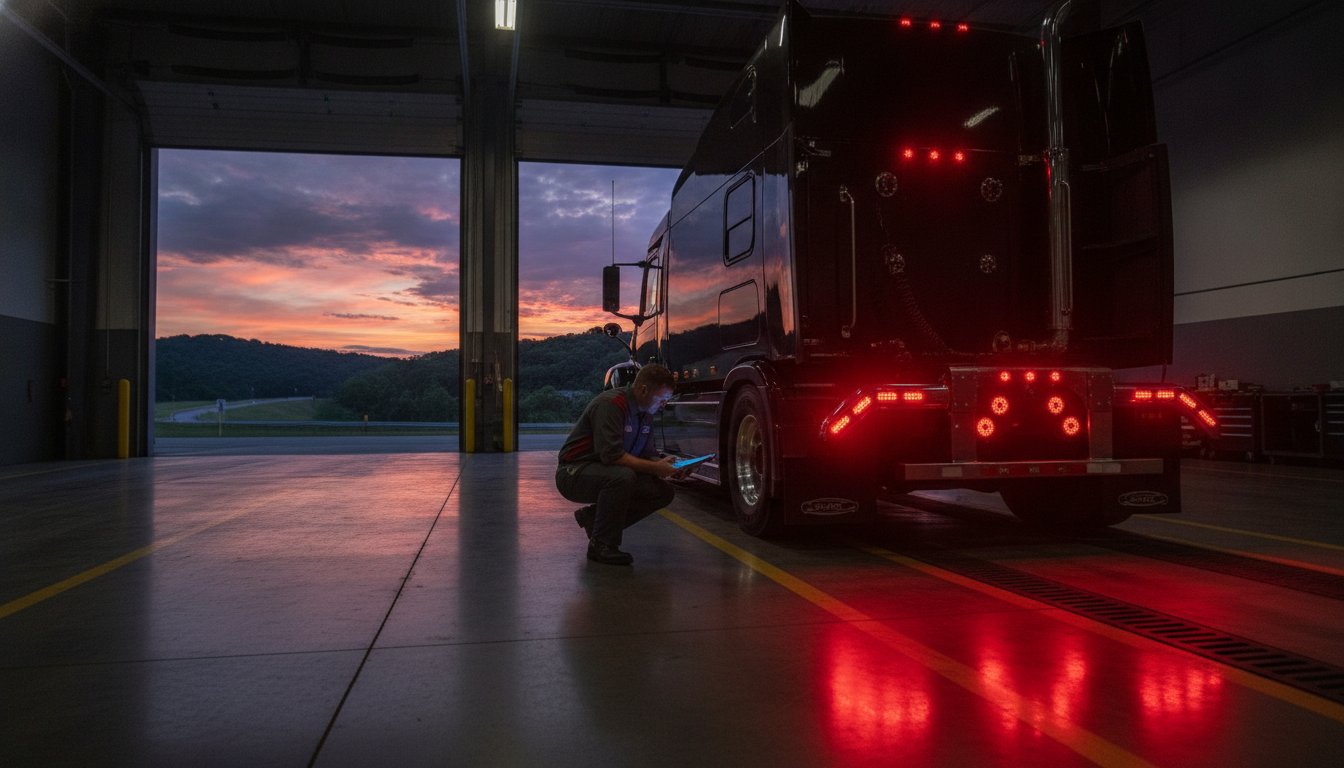
Did you know that brake and lighting violations remain the leading cause of out-of-service orders, even though a simple fifteen-minute pre-trip check can prevent ninety percent of them? On the high-stakes I-24 corridor, one small oversight leads to a costly roadside shutdown. Getting a professional DOT truck inspection Clarksville is your best defense against the Tennessee Highway Patrol's tightening enforcement. With eight of the nation's top one hundred bottlenecks located right here in Tennessee, you can't afford to lose time at a weigh station because of a faulty reflector or a worn brake pad.
We understand the stress of navigating the gray area between Tennessee and Kentucky enforcement lines while trying to keep your CSA score spotless. It's frustrating when a failed inspection turns a profitable haul into a week of downtime and unexpected repairs. This guide will show you exactly how to master 2026 compliance requirements, including the mandatory shift away from paper medical certificates, so you can pass your annual inspection on the first try. We will preview the latest regulatory updates and common failure points to ensure your fleet stays road-ready and moving.
Key Takeaways
- Understand the critical differences between the seven levels of DOT inspections and what specific components Tennessee Highway Patrol officers prioritize during roadside stops.
- Schedule a certified DOT truck inspection Clarksville to ensure your vehicles comply with the latest 2026 federal mandates and Tennessee state regulations.
- Identify the most frequent mechanical failure points, including brake system defects and electrical issues, to prevent expensive Out-of-Service (OOS) orders.
- Master a comprehensive pre-trip inspection checklist designed to catch minor maintenance gaps before they lead to major I-24 weigh station delays.
- Discover how professional fleet maintenance and timely inspections protect your CSA score and minimize operational downtime.
Navigating DOT Truck Inspections in Clarksville and Montgomery County
Clarksville is a critical hub for freight moving across the Tennessee and Kentucky border. For carriers running the I-24 corridor or moving loads along Highway 79, compliance isn't optional. The Tennessee Highway Patrol (THP) maintains a heavy presence in Montgomery County to ensure every commercial vehicle meets federal safety standards. If your truck or trailer has a Gross Vehicle Weight Rating (GVWR) over 10,001 pounds, you must complete a formal DOT truck inspection Clarksville every twelve months. This requirement applies to both interstate and intrastate carriers, though the specific USDOT number rules vary based on your weight and cargo.
Staying compliant protects your bottom line and your reputation. The THP looks for equipment failures that lead to accidents or road blockages in high-traffic areas. By securing a certified commercial vehicle inspection before you hit the scales, you eliminate the guesswork. This proactive approach is your best defense against the stress of an unannounced roadside stop. When your paperwork is in order and your equipment is sound, you spend less time at the weigh station and more time on the road.
The I-24 Corridor: A High-Enforcement Zone
The stretch of I-24 near Clarksville and Oak Grove is one of the busiest freight lanes in the region. Weigh stations in this area are high-enforcement zones where inspectors look for any reason to pull a rig aside. Roving highway patrols also monitor Montgomery County roads for visible defects like cracked windshields, flat tires, or flickering lights. If you operate out of Tennessee but pick up violations just across the line in Kentucky, those marks still hit your federal record. Local enforcement is thorough because they know the volume of traffic passing through this gateway daily.
Annual vs. Roadside Inspections: What is the Difference?
Drivers often confuse the mandatory annual 396.17 inspection with roadside stops. An annual inspection performed at a qualified shop is a planned, comprehensive review of your equipment. In contrast, a CVSA roadside stop is unannounced and often reactive. Shop-based inspections allow you to find and fix issues on your own schedule before they become legal problems. Roadside failures lead to immediate Out-of-Service (OOS) orders, expensive towing fees, and lasting damage to your carrier CSA score. A clean DOT truck inspection Clarksville ensures that when you do face a roadside officer, your rig is beyond reproach. High CSA scores lead to more frequent stops, while a clean record keeps your fleet moving without delay.
The 7 Levels of DOT Inspections: What Drivers Must Know
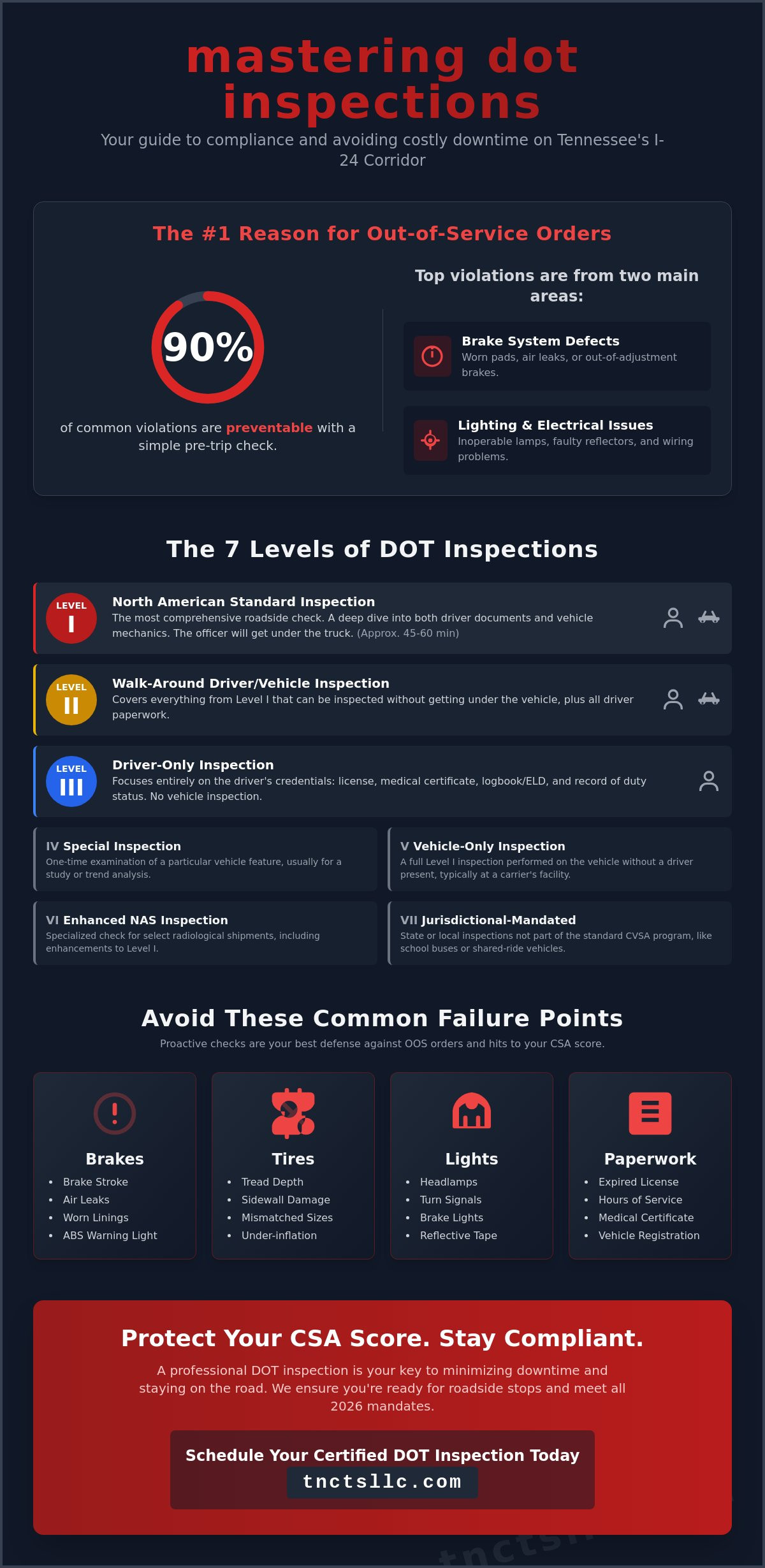
Knowledge is your best tool on the road. When a Tennessee Highway Patrol officer signals you to pull over, you need to know exactly what they are looking for. The 7 Levels of DOT Inspections define the scope of every roadside encounter; understanding these levels helps you prepare and stay calm under pressure. Each level has a specific focus, ranging from a simple paperwork check to a deep dive into your truck's mechanical systems.
Level I: The Most Comprehensive Safety Check
The North American Standard Inspection, or Level I, is the most rigorous review a driver will face. It covers both the operator and the vehicle in exhaustive detail. Inspectors crawl under the rig to measure brake stroke and check for frame cracks. They verify logbooks, medical certificates, and drug testing records. This process usually takes about 45 to 60 minutes. It is the baseline for a full DOT truck inspection Clarksville carriers must pass to maintain high safety ratings and avoid costly downtime.
Comparing Inspection Levels at a Glance
| Level | Scope | Focus Area |
|---|---|---|
| Level I | Full Vehicle & Driver | Complete mechanical and paperwork audit. |
| Level II | Walk-Around & Driver | Visual check of what is visible without getting under the rig. |
| Level III | Driver Only | ELD records, CDL, medical card, and seatbelt use. |
| Level IV | Special Study | One-time inspection of a specific item (e.g., tires). |
| Level V | Vehicle Only | Full mechanical check without the driver present. |
Level II walk-around inspections are common at Clarksville-area weigh stations because they are faster than Level I. Officers look for obvious defects like tire tread depth or leaking wheel seals. If they spot a violation during a Level II, they may escalate it to a full Level I. Level III is strictly about the operator. Even if your truck is brand new, failing a Level III due to an expired medical card or HOS violation will still sideline your operation. Preparing for a DOT truck inspection Clarksville means being ready for any of these scenarios at a moment's notice.
Specialized inspections also exist for specific hauls. Level VI is reserved for select shipments of radioactive materials, requiring an even higher standard of equipment readiness. Level VII is for jurisdictional requirements, covering items like school buses or shuttles. For most commercial haulers on I-24, Level I and Level II are the most frequent hurdles. Consistent fleet maintenance ensures your equipment is ready for any level of scrutiny, whether it is a planned shop visit or a surprise roadside check.
Common Failure Points: Why Trucks Get Sidelined in Tennessee
Failing a roadside check is a nightmare for any owner-operator. It stops your momentum and drains your profit instantly. In Tennessee, specific mechanical issues trigger an immediate Out-of-Service (OOS) order more often than others. Understanding these common pitfalls allows you to address them during your scheduled DOT truck inspection Clarksville before an officer spots them at the scales. When you know what the Tennessee Highway Patrol is looking for, you can stay one step ahead of the enforcement officer.
Most violations are preventable with consistent oversight. Inspectors often find that a single visible defect leads them to dig deeper into the vehicle's systems. If your truck looks neglected on the outside, they assume the mechanical components are in similar condition. Maintaining a clean, well-functioning rig is the first step in passing any level of inspection. Focus on the high-priority areas that historically cause the most downtime for carriers on I-24.
Brake and Air Leak Violations
Brake system defects remain the leading cause of OOS orders across North America. An audible air leak is an automatic red flag for any inspector. If an officer hears air escaping when you apply the service brakes, your trip will likely end at the weigh station. Brake adjustment limits are equally critical. Even a small amount of over-travel in a pushrod can lead to a failure during a Level I inspection. Regular semi-truck brake repair is the only way to ensure your stopping power meets federal standards. Don't wait for a warning light to address soft pedals or slow air pressure recovery.
Tire and Wheel Safety Standards
Tires are under constant scrutiny because they are the only point of contact with the road. You must maintain at least 4/32-inch of tread depth on steer tires and 2/32-inch on all other positions. Beyond depth, inspectors look for sidewall damage, dry rot, or exposed cords. A bulging sidewall is an instant OOS violation that requires immediate on-site replacement. Wheel seal leaks are another common trigger. If an officer sees oil residue sprayed on the inside of a wheel or brake drum, they know a bearing failure or brake contamination is imminent. Catching these leaks early during routine fleet maintenance prevents a massive repair bill on the shoulder of the highway.
Lighting and load securement round out the list of frequent failure points. Don't let a five-dollar bulb ruin your schedule. A single burnt-out clearance light or a flickering turn signal invites a more thorough investigation of your entire rig. Similarly, trailer structural integrity is non-negotiable. Cracked cross-members or holes in the floorboards suggest poor maintenance habits. When you invest in professional DOT truck inspection Clarksville services, you identify these structural and electrical issues in a controlled environment rather than under the pressure of a roadside audit.
The Ultimate Pre-DOT Inspection Checklist for 2026
A thorough daily pre-trip inspection is your strongest defense against a surprise roadside shutdown. Most scale failures are preventable in the yard. By the time you reach an enforcement officer on I-24, it's too late to fix a simple bulb or a loose wire. Use this checklist to ensure your next DOT truck inspection Clarksville is a success. Taking fifteen minutes every morning protects your CSA score and keeps your freight moving without legal interference.
Start with the exterior and coupling components. Test every light on the rig. This includes high and low beams, turn signals, and four-way flashers. Don't forget the clearance and identification lights on the top of the cab and trailer. Inspect the fifth wheel to ensure the locking jaws are fully engaged around the kingpin and the release lever is seated. Finally, verify your documentation is current. Your ELD must be compliant, your medical certificate must be updated in the state system, and your annual inspection sticker must be legible and properly placed.
Interior Cab and Driver Requirements
Your cab must be a compliant workspace. Inspectors check for a fire extinguisher that is fully charged, pinned, and securely mounted. It cannot be rolling around on the floor or tucked loosely behind a seat. You also need three bidirectional emergency reflective triangles in good condition. Check your seat belt for fraying or damage. If the retractor doesn't lock or the buckle is cracked, you will face an immediate violation. Testing your horn and wipers is also essential. Both the city horn and air horn must function, and wipers must clear the windshield without streaking while the washer fluid pump sprays effectively.
Fluid Leaks and Engine Compartment
Inspectors differentiate between "seepage" and an "active" leak. A damp component might pass, but a steady drip will sideline your truck. Focus on the power steering pump, wheel seals, and the engine block. Professional diesel engine services make this inspection faster. A clean engine allows you to spot fresh leaks immediately and shows the inspector you prioritize maintenance. Check the steering linkage for excessive play and ensure all suspension components, like leaf springs and U-bolts, are free of cracks or shifts. Dashboard warning lights, specifically for ABS or engine systems, must be addressed before you hit the road.
If you find an issue during your pre-trip, don't risk the road. Get professional fleet maintenance now to stay compliant and profitable.
Certified DOT Inspections at Complete Truck Services LLC
Your compliance strategy is only as strong as the technicians inspecting your gear. At Complete Truck Services LLC, we provide a thorough DOT truck inspection Clarksville that goes beyond a simple sticker. Our certified diesel technicians understand the nuances of federal and Tennessee state law. We don't just find problems; we offer immediate solutions. If a component fails to meet safety standards, our shop is equipped to handle the necessary repairs on the spot. This integrated approach saves you from the frustration of failing an inspection and then hunting for a repair shop while your truck is sidelined.
Our facility is strategically positioned to serve carriers moving through Clarksville, Oak Grove, and the critical I-24 corridor. We prioritize uptime because we know that every hour your truck spends in a bay is an hour it isn't generating revenue. By combining our inspection services with comprehensive fleet maintenance, we help you stay ahead of the DOT and maintain a pristine CSA score. We act as your technical specialist and dedicated service provider, ensuring your equipment meets the highest standards of the industry.
Why Trust Complete Truck Services LLC?
We focus exclusively on commercial heavy-duty vehicles. You won't find passenger cars or light-duty trucks clogging our service bays. This specialization allows our team to maintain a deep expertise in complex air brake systems, heavy-duty suspension, and diesel engine services. We provide absolute transparency in our reporting. Every finding is explained clearly, and we prioritize repairs based on safety and compliance needs. Our proximity to I-24 makes us an ideal partner for long-haulers who need a reliable stop between major hubs and local fleets that require consistent, professional oversight.
24/7 Support for Inspection Failures
The worst-case scenario is an Out-of-Service order at a roadside weigh station. If you find yourself in this situation, our 24/7 Road Rescue team is ready to respond immediately. We provide mobile diesel repair to address OOS violations on-site, whether it's a blown air bag, a broken wheel seal, or a lighting failure. Our goal is to restore your operation as quickly as possible. We act as your dependable partner in high-stakes situations; providing the technical precision needed to clear your violations and get you back on the road without unnecessary delays. We understand the stress of downtime and work with urgency to resolve your mechanical hurdles.
Schedule your certified DOT inspection in Clarksville today!
Secure Your Fleet's Future on I-24
Compliance is a strategic advantage, not just a legal hurdle. By mastering the seven levels of inspections and implementing a rigorous daily checklist, you protect your CSA score and your profitability. A proactive DOT truck inspection Clarksville ensures that when you hit the scales, your equipment is beyond reproach. You shouldn't have to worry about unannounced roadside shutdowns or the confusion of border-state enforcement. Staying ahead of the Tennessee Highway Patrol means your freight stays moving and your reputation stays clean.
As a locally owned and operated partner in Clarksville, we are dedicated to keeping your heavy-duty vehicles moving. Our specialized diesel technicians focus strictly on commercial fleets, ensuring every mechanical system meets 2026 standards. If the unexpected happens, our 24/7 Emergency Road Rescue is always ready to restore your operations and clear out-of-service orders on-site. Don't wait for a red tag to address your maintenance needs. Precision in the shop leads to confidence on the highway.
Book Your DOT Inspection with Complete Truck Services LLC today. Keep your fleet compliant and your schedule on track.
Frequently Asked Questions
How long is a DOT annual inspection valid in Tennessee?
A DOT annual inspection remains valid for exactly 12 months from the date of the inspection. Motor carriers must ensure every commercial vehicle in their fleet undergoes this review at least once a year to stay compliant with federal and state regulations. If you travel more than 100,000 miles annually, some industry professionals recommend bi-annual checks to catch wear early and prevent unexpected mechanical failures.
What is the difference between a state inspection and a federal DOT inspection?
In Tennessee, the annual DOT inspection is the federal requirement under FMCSR 396.17, while "state inspections" usually refer to emissions or weight-specific checks. For commercial haulers, the federal DOT standard is the primary safety benchmark enforced by the Tennessee Highway Patrol. This ensures your rig meets the same safety criteria whether you are driving in Clarksville or crossing state lines into Kentucky.
Can I drive my truck if I fail a DOT inspection?
You cannot legally operate a truck that has received an Out-of-Service (OOS) order during an inspection. If the inspector identifies critical safety defects, like major air leaks or failed brakes, the vehicle must be repaired on-site or towed to a shop. Driving a vehicle with an active OOS order leads to heavy fines and severe damage to your carrier's safety rating and insurance premiums.
How much does a DOT inspection cost in Clarksville?
The cost of a DOT truck inspection Clarksville depends on the service provider and the complexity of your specific equipment. While prices fluctuate across Montgomery County, most carriers view the fee as a small investment compared to the thousands of dollars lost during a roadside shutdown. You should contact a local certified shop directly to get current rates for your specific vehicle type and fleet size.
What are the most common Level 1 DOT inspection violations?
Brake system defects and inoperative lighting remain the most frequent violations found during a Level 1 inspection. Officers prioritize these systems because they are critical for preventing accidents on high-speed corridors like I-24. Other common issues include tire tread depth below the legal limit and unsecured cargo. Addressing these items during your daily pre-trip routine is the most effective way to avoid a failure.
Do I need a DOT inspection for a trailer in Tennessee?
Yes, every trailer operated as part of a commercial motor vehicle over 10,001 pounds GVWR requires an annual DOT inspection. The inspector checks the trailer's frame, floor, lighting, brakes, and tires to ensure structural and mechanical integrity. Neglecting trailer maintenance is a common mistake that leads to roadside delays, even if the tractor itself is in perfect condition and passes its own review.
What happens if my DOT inspection sticker is expired?
Operating with an expired inspection sticker makes you a primary target for the Tennessee Highway Patrol and can lead to immediate fines. If you are stopped at a weigh station with an outdated sticker, you will likely be subjected to a full Level 1 inspection. This increases the risk of finding other violations that could result in an Out-of-Service order and negative points on your CSA score.
Can a mobile mechanic perform a certified DOT inspection?
A mobile mechanic can perform a certified DOT truck inspection Clarksville as long as they meet the federal qualifications set by the FMCSA. They must have the proper training and tools to conduct a comprehensive safety review according to federal standards. Many fleet owners prefer shop-based inspections for more complex repairs, but mobile services are a reliable solution for clearing OOS orders on the shoulder of the highway.